
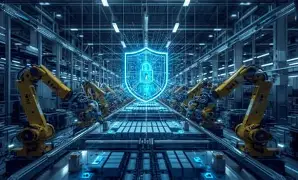
Connecting machines and sensors to a network unlocks valuable data, but it also creates new entry points for cyber threats. Building security in from the start is far easier than adding it later.
The Business Problem
Many industrial machines were designed for isolated networks and were never built with internet connectivity in mind. Connecting them without planning can expose the factory to risk:
- Default passwords left unchanged on devices and gateways
- Machines directly reachable from the internet
- Office and production networks mixed together
- No record of who accessed which system and when
A security incident can stop production, damage equipment or expose sensitive data.
Practical Explanation
1. Keep machines off the public internet
Use edge gateways as the only devices that communicate with the cloud, so machines themselves are never exposed.
2. Separate networks
Keep production equipment on its own network segment, separated from office IT systems.
3. Change default credentials
Replace default passwords on every device and use unique, strong credentials.
4. Encrypt data in transit
Make sure data travelling from gateways to the cloud is encrypted.
5. Control access by role
Give operators, engineers and managers access only to what they need.
6. Keep software up to date
Apply security updates to gateways and platforms on a regular schedule.
7. Monitor and log activity
Record access and unusual activity so issues can be spotted and investigated.
Implementation Considerations
- Involve IT and operations together: security decisions affect both teams
- Inventory devices: keep an up-to-date list of every connected device and its software version
- Prefer read-only data collection: where possible, collect data without allowing remote control of machines
- Plan for updates: agree who is responsible for updating gateways and how updates are tested
- Review regularly: security is an ongoing process, not a one-time project
Industry Examples
- Automotive suppliers: production networks are separated from office networks, with gateways as the only link to the cloud
- Pharmaceuticals: role-based access and audit logs support data integrity requirements
- Multi-site manufacturers: central management of gateway credentials and updates keeps every site consistent
Frequently Asked Questions
Is it safe to send factory data to the cloud?
It can be, when data is encrypted in transit, devices use secure credentials and only gateways communicate with the cloud. On-premise options also exist where policies require it.
Can IoT devices be used to control our machines remotely?
They can, but many projects start with read-only data collection. Remote control should only be enabled where there is a clear need and proper safeguards.
Who should be responsible for IoT security?
Ideally IT and operations share responsibility: IT for networks and access policies, operations for how devices are used on the factory floor.