
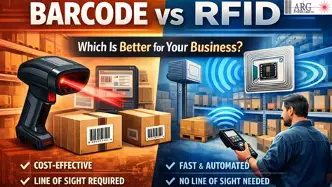
Barcodes and RFID both give every item a digital identity, so you can track materials, products and assets through your operation. But they suit different jobs, and many factories end up using both. This guide explains how to choose.
The Business Problem
Without reliable identification, factories rely on manual counts, handwritten labels and data typed in by hand. The results are familiar:
- System stock that rarely matches what is on the shelves
- Wrong or incomplete shipments reaching customers
- Slow stock counts that tie up staff for hours or days
- No clear traceability when a quality question arises
Choosing the wrong identification technology can be just as costly, either by overspending on RFID where barcodes would do, or by forcing staff to scan items one by one where RFID would be faster.
Practical Explanation
How they differ
A barcode is printed on a label and read by a scanner that needs a clear line of sight. Items are scanned one at a time. An RFID tag contains a small chip and antenna and is read by radio waves. RFID readers can capture many tags at once, without line of sight, and often without anyone holding a scanner.
When barcodes are the better choice
- Low cost per item matters, because labels cost very little to print
- Items are already handled one at a time, such as at a packing station
- Customers require specific barcode label formats
When RFID is the better choice
- You need hands-free tracking as items pass doors, docks or conveyors
- Whole pallets or trolleys must be counted or verified in seconds
- Reusable assets such as bins, tools and containers need tracking over many cycles
Implementation Considerations
- Test on site: metal surfaces and liquids can affect RFID read rates, so run a trial with your real items before committing
- Tag and label durability: choose materials that survive heat, chemicals, abrasion or washdown in your process
- Reader placement: for RFID, plan portal and antenna positions around how goods actually move
- System integration: make sure scans or reads update your ERP or warehouse system automatically
- Cost per use: compare the cost of tags or labels with how often each item is tracked and reused
Industry Examples
- Food packaging: barcode labels printed from ERP data identify every case for customers and retailers
- Automotive parts warehousing: RFID portals at dock doors verify whole pallets against orders before dispatch
- Mixed approach: a manufacturer uses barcodes on individual products and RFID on returnable containers shared with suppliers
Frequently Asked Questions
Is RFID always more expensive than barcodes?
Per item, RFID tags cost more than printed labels, and readers cost more than scanners. But RFID can reduce labour and errors significantly in high-volume or hands-free processes, so the total cost depends on how you use it.
Does RFID work on metal parts and liquids?
Yes, with the right tags. Standard tags can struggle near metal and liquids, so on-metal and specialised tags are used, and an on-site test confirms performance before rollout.
Can barcodes and RFID be used in the same system?
Yes. Many sites use barcodes on individual products and RFID on pallets, bins or returnable containers, with both feeding the same ERP or warehouse system.